Note
Go to the end to download the full example code.
A gas-filled hollow rectangular waveguide#
A hollow silica channel 250 um wide and 100 um high, filled with 5 bar of argon, guides
a 30 fs, 800 nm pulse in its lowest x-polarised mode. The mode is supplied as an object
(RectMode) to the waveguide route, which binds it
to the route’s fill, and the run is a plain
prop_waveguide(): the waveguide route’s starting point,
and the call its example recipe mirrors (Recipe.example("hollow_rectangular")).
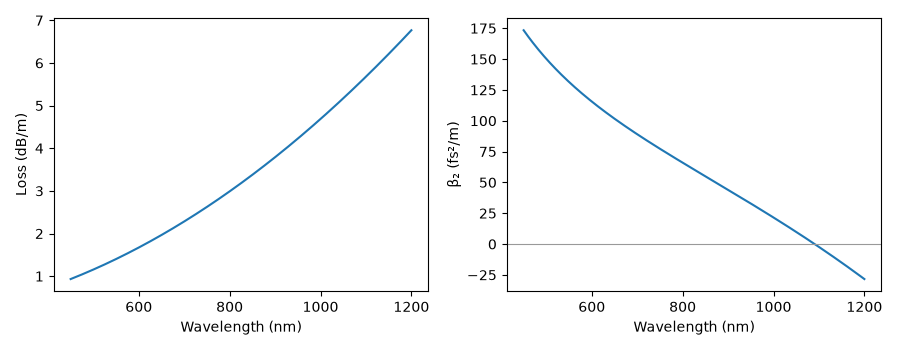
The first chart is the mode’s loss and dispersion across the band; the second the spectrum at the entrance and after 20 cm, broadened by self-phase modulation.
from time import perf_counter

import matplotlib.pyplot as plt
import numpy as np

from solprop.constants import C
from solprop.driver import prop_waveguide
from solprop.modes import RectMode
from solprop.modes.base import beta2, db_per_m
from solprop.plotting import spec_1d
from solprop.stats import StatsSpec

started = perf_counter()
The mode#
The half-widths are 125 um in x and 50 um in y; the field is polarised along x, the wide side, which has the lower loss: 3 dB/m at 800 nm. The loss grows as the cube of the inverse height, so half the height is eight times the loss. The cladding is fused silica by default. Built here with the fill, the mode’s loss and dispersion can be drawn before any run; the route rebinds it to its own fill.
mode = RectMode(125e-6, 50e-6, "Ar", 5.0)
wavelength = np.linspace(450e-9, 1200e-9, 300)
omega = 2 * np.pi * C / wavelength
figure, (loss_axis, dispersion_axis) = plt.subplots(1, 2, figsize=(9, 3.5))
loss_axis.plot(wavelength * 1e9, db_per_m(mode, omega))
loss_axis.set(xlabel="Wavelength (nm)", ylabel="Loss (dB/m)")
dispersion_axis.plot(wavelength * 1e9, beta2(mode, omega) * 1e30)
dispersion_axis.axhline(0.0, color="0.6", linewidth=0.8)
dispersion_axis.set(xlabel="Wavelength (nm)", ylabel="β₂ (fs²/m)")
figure.tight_layout()
The run#
One mode, so the launch needs no table; the energy is a literal. The envelope grid leaves out the third harmonic, which this short guide does not phase-match, and argon has no Raman response. The transverse quadrature of the nonlinear overlap uses 12 by 12 nodes.
run = prop_waveguide(
    [RectMode(125e-6, 50e-6)],
    0.2,
    "Ar",
    5.0,
    wavelength=800e-9,
    wavelength_limits=(450e-9, 1200e-9),
    trange=200e-15,
    fwhm=30e-15,
    energy=20e-6,
    envelope=True,
    plasma=False,
    n_r=12,
    n_theta=12,
    n_save=11,
    stats=StatsSpec(names=("energy",)),
    seed=1,
)
spec_1d(run, [0.0, 0.2], spec_range=(600e-9, 1050e-9))
print(f"Transmitted energy: {run['stats/energy'][-1].sum() * 1e6:.4f} uJ")
print(f"Complete hollow rectangular example: {perf_counter() - started:.3f} s")
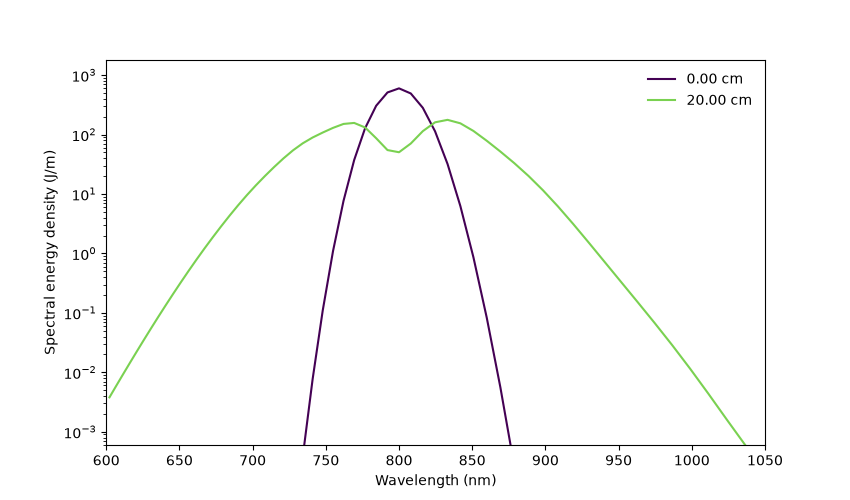
Transmitted energy: 17.4235 uJ
Complete hollow rectangular example: 0.760 s